Former gang members and ex-prisoners lend a helping hand to people who are afraid to go out onto the streets to sell their products.
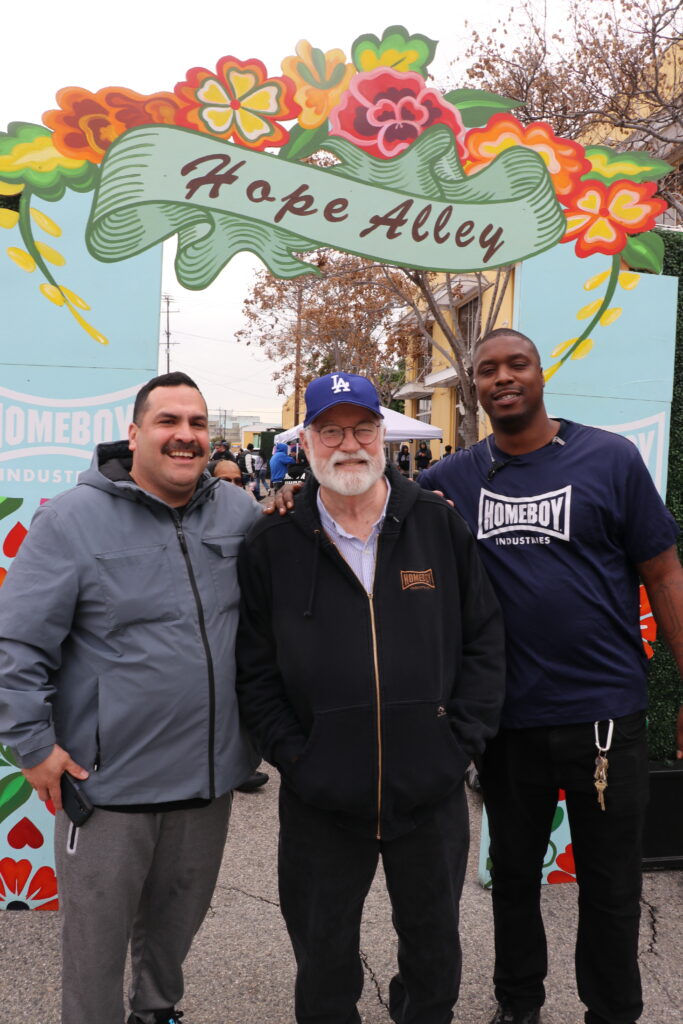
The Jesuit priest, Greg Boyle, devised an altruistic way to help street vendors in Los Angeles, through Hope Alley.
Every third Friday of the month, the small Bruno Street in Los Angeles transforms into “Hope Alley,” where former gang members and ex-prisoners show compassion and solidarity to undocumented street vendors and their families.
“Hope Alley,” a project developed in collaboration with Father Greg Boyle, founder of Homeboy Industries, is a space created to offer support to immigrant vendors affected by ICE raids by promoting the sale of food and other items to raise funds.
The initiative involves inviting vendors to work from mobile stands, with all profits going to them.
“The most important word in these efforts is hope. We want to offer hope to the immigrant vendors who are staying home for fear of ICE,” declared Father Gregory Boyle. “We want to do our part to offer them hope.”
The Jesuit priest observes that the phenomenon of people treating other human beings with such cruelty by ICE agents as if they were animals “doesn’t come from anyone who is in their right mind.”
“No one in their right mind can agree with this effort by President Trump,” he added. “They’re sick, poor people, because they don’t want to see others as human beings with dignity who deserve their respect.”
“We have to go out and work.”
José M. López, who is married to María Cortés and has five children, has visited “Hope Alley” multiple times. He owns the “Birria Los Amigos” food stand.
“Now my work is more difficult,” said Diaz, who received help from the “Homies,” Maria Santos and Romell Thomas, in delivering the taco orders.
López, 53, said that since arriving in the United States, he has worked in kitchens and restaurants and, over time, had the opportunity to open his own business. However, sales have plummeted since 2025 due to immigration raids.
“Even though many of us don’t have papers, we shouldn’t be afraid because we have to go out and work,” said the man born in Guadalajara, Jalisco.
Three of his customers—Dave Vázquez, Cynthia Huizar, and Anthony López—valued the importance of supporting street vendors in Ángeles and emphasized community solidarity in the face of attacks by the federal government against undocumented immigrants.
“I came to support my people because of everything that’s happening,” said Dave. “I love supporting my people. We need to help our community; “We need to help each other because the government isn’t going to.”
The 29-year-old added that the mistreatment his Latino brothers and sisters receive should not happen, “because we all live on land stolen [from Native Americans] and we should all be treated equally,” he said. “We all deserve the opportunity to live on stolen land.”
The Privilege of Solidarity
Cynthia Huizar emphasized that she felt “privileged” to help her “brothers and sisters.”
“They are our people and they do so much for us,” she stated. “Everything we eat every day is prepared by them, and we all have the opportunity to help immigrants.” “That’s what our parents and grandparents in Guatemala did and taught us.”
Huizar criticized the September 2025 ruling by the U.S. Supreme Court, which paved the way for racial discrimination during immigration raids and operations based on physical appearance, language, and accent.
“It’s not right, because we shouldn’t be judged by our appearance or how we present ourselves,” he said. “You know, I come from a background where my whole family was in gangs. My grandfather was a gang member. My grandmother lived in the barrio.” But do you know what? Who we are today does not justify who we were then.”
In a 6-3 vote in the case known as Vásquez Perdomo v. Noem, the Supreme Court granted an emergency request from the Trump administration. It temporarily suspended a Los Angeles judge’s order prohibiting “roaming patrols” from stopping people on the streets of California and questioning them about their appearance, language, occupation, or even their location. Both a federal court in Los Angeles and the Ninth Circuit Court of Appeals had ruled that these actions constituted illegal racial profiling.
Anthony López also said he felt privileged to cooperate with the cause of helping street vendors.
“Thank you for the opportunity. It is the first time I have done this, I am open to it, and I hope to have more opportunities to help soon,” he emphasized.
Restoring Dignity and Human Respect
Shirley Torres, program director at Homeboy Industries, explained that the mobilization of human resources within the nonprofit organization to support the street vendor community was initiated by the “homies” [friends] themselves, who want to help their brothers and sisters who are staying home and living in fear.
“We want to give dignity and respect to everyone who wants to earn a living,” she said. “The American Dream is for everyone. That is why we created and transformed a block into Hope Alley… We are not going to give up.”
Meanwhile, José Arellano, who began his career at Homeboy Industries in 2013 as an apprentice and rose to vice president of operations, where he leads organizational initiatives, stated that, like everyone else, he witnessed the injustice inflicted on the immigrant community.
“We have always been an organization that supports the marginalized and the demonized, and we knew we had to do something,” he said. “We thought about the undocumented street vendors, and that connects us to the workforce we have here. We knew our colleagues would want to participate and support. So, we wanted to create something safe and healthy for them, so they could persevere.”
Perseverance is what María Chavez, originally from Zapotiltic, Jalisco, is doing. She sells chocolates, stuffed animals, crafts, and floral arrangements.
“I came to buy a heart-shaped flower for my girlfriend,” said Juan Laguna. “This flower never wilts.”
Mabel Gastelum arrived at the stall of Marlene Jiménez, an immigrant from Valle de Chalco, State of Mexico, to buy a vanilla flan.
“I’ve only sold two flans so far, but I hope more people come to buy,” said Marlene. “I’m hopeful that sales will go well by the end of the day.” Federico Díaz, a vendor of mangonadas—a Mexican frozen dessert combining mango pulp, chamoy, lime juice, and chili powder, along with fried snacks—shared the same concerns: “It’s cold, and that makes sales harder.”
Díaz, 42, originally from Puebla, Mexico, said that “living in fear is difficult,” even though the Callejón de la Esperanza (Alley of Hope) is a restricted area, where Immigration and Customs Enforcement (ICE) agents could never enter.
“During the week, I sell on a street in Koreatown. The masked ICE agents have been close by two or three times already,” he revealed. “But as soon as they tell us, I leave my cart parked on the street and come back two or three hours later, when they’re gone.”
AYUDANOS A COMPARTIR