Trump’s hateful rhetoric has fueled the exponential rise in hate crimes, as evidenced by the murders of six Asian women in Atlanta and four Sikhs in Indianapolis.
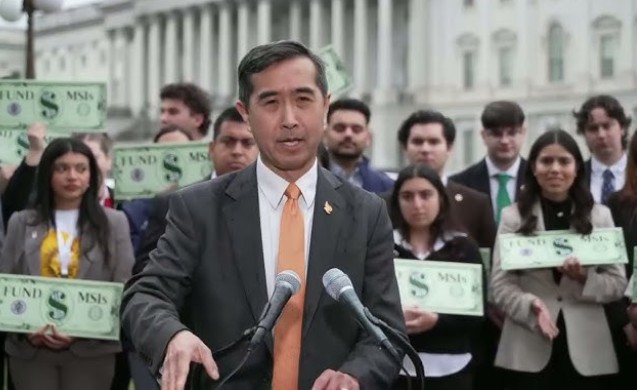
“Regrettably, we currently have a president [Donald Trump] who does nothing but add fuel to that fire of hate,”: John C. Yang, President and CEO of Asian American Justice Center (AACJ).
Hate crimes against people of Asian descent have surged by 300% compared to pre-pandemic levels. Trump’s public rhetoric since his first term (2016–2020) has played a pivotal role in fueling this hatred, directly correlating his words to the rise in hate crimes.
Preliminary hate crime data released by the Federal Bureau of Investigation (FBI) for the year 2025 indicate a decrease in the total number of incidents reported nationwide; however, these figures reveal persistent and troubling threats directed at Asian Americans and Pacific Islanders (AAPI), religious communities, Latinos, and individuals perceived as immigrants.
The overall preliminary data underscore ongoing risks and drastic spikes targeting specific communities, despite widespread underreporting driven by fear, language barriers, and inconsistencies in reports submitted by law enforcement agencies.
John C. Yang, President and Executive Director of Asian Americans Advancing Justice (AAJC), stated that the organization has published a detailed analysis of the FBI’s preliminary 2025 hate crime data. This analysis demonstrates how chronic underreporting, data gaps, and inconsistent participation by law enforcement agencies obscure the true magnitude of hate-motivated harm across the country. Hate crimes against Asians remain at alarmingly prominent levels, more than double the annual average recorded prior to the pandemic (between 2013 and 2018), which stood at 133 incidents per year.
In 2025, 318 hate crimes were recorded—a figure approximately 2.4 times higher—even though the number of reported incidents decreased by 16% compared to the 379 cases recorded in 2024.
Hate crimes against Native Hawaiians and Pacific Islanders (NHPI) dropped to 20 single-bias incidents, representing a 31% decrease compared to the 29 cases recorded in 2024.
Hate crimes against Sikhs skyrocketed to levels never before recorded by the FBI: 226 incidents, marking a 59% increase over the 142 recorded in 2024; against Hindus, they rose to 28 incidents—a 12% increase over the 25 recorded in 2024—and against Buddhists, they climbed to 32 incidents—a 23% increase over the 26 recorded in 2024.
Conversely, hate crimes against Muslims decreased slightly to 199 incidents, representing a 13% decline compared to the 228 recorded in 2024.
Trump Fuels the Fire of Hate
On the 35th anniversary of the AAJC’s founding, John C. Yang described “the stark reality” of anti-immigrant rhetoric, which has reached an all-time high, that, despite the progress achieved, he deemed to have “skyrocketed to alarming levels.”
“Regrettably, we currently have a president [Donald Trump] who does nothing but add fuel to that fire of hate,” said Yang.
Recently, the president of the United States shared on its social media channels a diatribe by an ultraright-wing radio host who branded immigrants from India and China as “gangsters with laptops.”
The host in question characterized these nations as “hellhole countries”—a phrase that echoes the way the President himself has described other nations.
The diatribe further included the assertion that Asian Americans are disloyal to the United States and that, somehow, they fail to integrate into the country—much as, in his words, “Europeans did in the past.”
“This, then, is part of the context we must keep in mind,” noted Young during an informational session hosted by American Community Media (ACoM).
The Persecution of the Southern Poverty Law Center
In a broader context, the Executive Director of the AACJ pointed out that all of this is unfolding at a time when the Department of Justice has filed an unfounded criminal complaint against the Southern Poverty Law Center (SPLC)—an organization with a 50-year track record dedicated to preventing hate and unmasking white supremacist groups such as the KKK, the Proud Boys, and the Oath Keepers.
“We also have a federal government that has—mid-contract—canceled grants intended to combat hate crimes.”
These grants actively seek to prevent both hate crimes and hate incidents.
Furthermore, the Trump administration is pressuring social media companies to scale back their content moderation efforts.
“When we have a federal government that not only fails to prevent hate incidents but actively engages in conduct and rhetoric that incites them, all Americans suffer,” he stated. “And what we have at this moment is a story that combines both progress and lost progress.”
Five years ago, the Asian American community became the epicenter of pain and fear. As the COVID-19 pandemic ended, President Trump continued to stigmatize the community, calling the health crisis the “China virus,” the “Wuhan flu,” and the deeply offensive “Kung flu.”
“Trump genuinely laughed at the use of these terms during campaign rallies,” Yang recalled. “Anti-Asian hate reached staggering levels, as documented by Stop AAPI Hate, and in March 2021, six Asian American women were murdered in Atlanta.”
The Murders of Four Sikh Americans
Additionally, four Sikh Americans lost their lives in the heartbreaking shooting at the FedEx facility in Indianapolis.
Consequently, the COVID-19 Hate Crimes Act passed. It was a timely response to the situation facing Asian, Sikh, and Muslim communities.
This legislation helped establish—among other things—non-policing measures and avenues for reporting hate incidents and obtaining assistance.
The Act strengthened the AAJC’s hate-response infrastructure, improving access to reporting systems, the availability of language services, and the coordination of care for the elderly.
The current situation is one of regression, with hate crimes remaining at alarmingly high levels. John C. Yang emphasized that, although figures based on FBI data don’t match the magnitude of 2020-2022, the incidence is nearly three times higher than pre-pandemic levels, driven by continuing antagonistic rhetoric and policy decisions.
While reported acts of hate against the Sikh, Hindu, and Buddhist communities have reached the highest levels ever recorded, hate directed at the Latino community remains significantly elevated, having reached its highest reported figure in over a decade.
Furthermore, what the statistics fail to reveal is that hate crimes remain subject to widespread underreporting.
In part, this is due to a fragmented infrastructure, wherein various organizations and government agencies lack the incentives to report both hate crimes and hate incidents.
“There are those who attempt to minimize what is actually happening on the ground; however, the reality is that the public does not feel safe,” stated John C. Yang. “These concerns are exacerbated by the oppressive enforcement of immigration policies, as well as by concerns regarding police conduct—stemming from reduced oversight driven by the Trump administration—and the new perspective adopted by the Department of Justice (DOJ).”
Likewise, part of this problem lies in the fact that the very notion of what it means to be “American” is under attack, following the administration’s attempt to eliminate birthright citizenship.
“Perpetual Foreigners” in the United States
The expert noted that the idea has been fostered that, somehow, it is white majorities who are being subjected to discrimination, suggesting that efforts to address this issue should focus on them, rather than on inclusion, equity, and diversity. “Another aspect is that the stereotype of us—Asian Americans—as ‘perpetual foreigners’ has resurfaced; the idea that we are permanent outsiders who could never truly become Americans,” he noted. “And this is happening despite the fact that this notion never entirely disappeared.”
It is precisely now that the post Trump shared—from a right-wing radio host—becomes relevant: the notion that, somehow, “we pose a risk to the national or economic security of the United States.”
“We have seen this script before: whether during World War II, with the internment of Japanese Americans; in the aftermath of 9/11, with the persecution directed against Arabs, Muslims, and Americans of Middle Eastern and South Asian descent; or even going back to the Chinese Exclusion Act, to the era when Chinese railway workers contributed to the construction of the transcontinental railroad. In my view, this is the context that shapes how Trump’s publication should be understood. It is vital for the public and policymakers to recognize these patterns and actively support measures to combat hate crimes, address systemic underreporting, and promote inclusion and safety for all communities.” Yang said.